Motor Deficits in the McGill-R-Thy1-APP Transgenic Rat Model of Alzheimer's Disease
Abstract
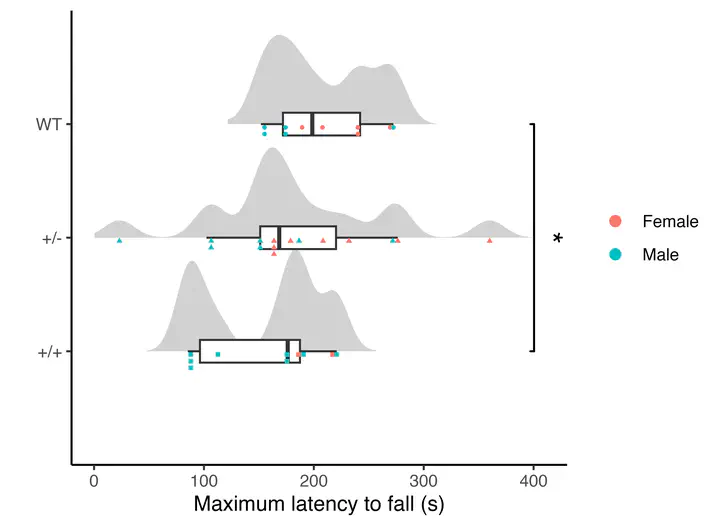
The McGill-R-Thy1-APP rat is a transgenic model of Alzheimer’s disease (AD) which expresses APP with two mutations found in cases of familial AD, resulting in the development of amyloid pathology and cognitive deficits. Motor deficits are common symptoms of AD, emerging early in the disease, and are correlated with AD neuropathology and cognitive symptoms. This study evaluated hemizygous and homozygous McGill-R-Thy1-APP rats and their wildtype littermates for spontaneous alternation and locomotion in the T and Y mazes, and motor behaviour on an accelerating rotarod at 12–13,months of age. We found no genotype or sex effects in spontaneous alternation in either maze, nor a significant correlation of spontaneous alternation behaviour between the mazes. Female rats travelled greater distances than male rats in both mazes. While there was no genotype effect in the T maze on distance travelled, in the Y maze the hemizygous rats travelled shorter distances than the wildtype rats, while the homozygous rats travelled greater distances. There was a significant correlation between the distances travelled in each maze. Both hemizygous and homozygous rats performed worse than their wildtype littermates on the rotarod, while heavier rats performed worse than lighter rats, and female rats performed worse than male rats once their differences in weights were accounted for. These findings support the continued use of these rats as a model of AD and highlight the need to consider the possible confounding effect motor impairments have on other behavioural tests.
Open access pdf.

Kyle Roddick
Assistant Professor
Kyle Roddick is an assistant professor in the Department of Psychology, Mount Allison University.