Kyle Roddick is an assistant professor in the Department of Psychology, Mount Allison University. His research interests include behavioural neuroscience, learning and memory, transgenic disease models, and quantitative methods.
PhD in Psychology/Neuroscience, 2023
Dalhousie University
MSc in Psychology/Neuroscience, 2012
Dalhousie University
BSc in Neuroscience, 2010
Dalhousie University
Responsibilities include:
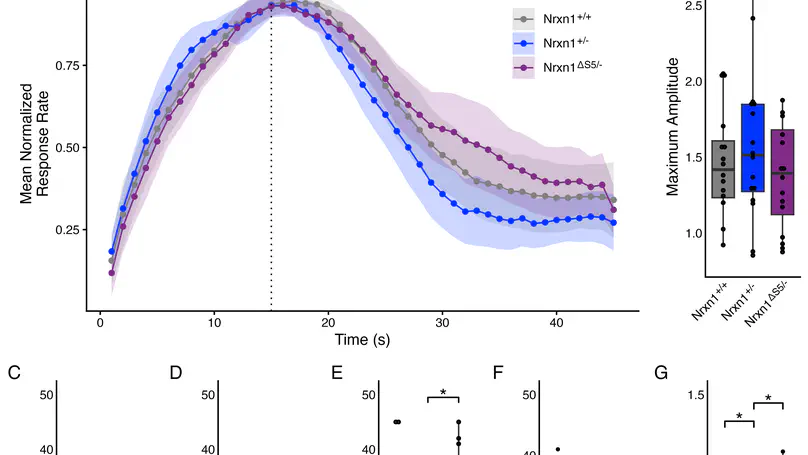
Autism spectrum disorder (ASD) is characterized by impaired social interactions and communication, and increased repetitive and stereotypical behavior. Neuroimaging shows functional abnormalities in brain areas involved in temporal processing in autistic individuals, and they also show deficits in interval timing. Neurexin (NRXN) mutations have been identified in a wide variety of neuropsychiatric disorders, including ASD, and Nrxn1+/- mice possess a mutation that disrupts the $α$, $β$, and $γ$ isoforms of Nrxn1, a gene involved in synapse structure. We investigated the interval timing abilities of the Nrxn1+/- mouse model of ASD in the peak interval procedure using a 15-s target interval and compared their performance with that of Nrxn1+/+ and Nrxn1$Δ$S5/- rescue mice. Two-month-old male Nrxn1+/+ (C57BL/6 J), Nrxn1+/-, and Nrxn1$Δ$S5/- mice were trained to obtain sucrose liquid rewards 15 s after the onset of a discriminative stimulus (discrete fixed-interval training), and their timing responses were tested in non-reinforced probe trials. Our analysis of responses across individual trials revealed that Nrxn1+/- mice had earlier timing responses overall. This difference was manifested as earlier termination of responding in terms of the response curves. These findings are consistent with leftward shifts observed with experimental animal models of ASD. In conclusion, we believe these results indicate a bias in long-term memory in the Nrxn1+/- mouse model of ASD and may capture the timing deficit observed in autistic individuals.
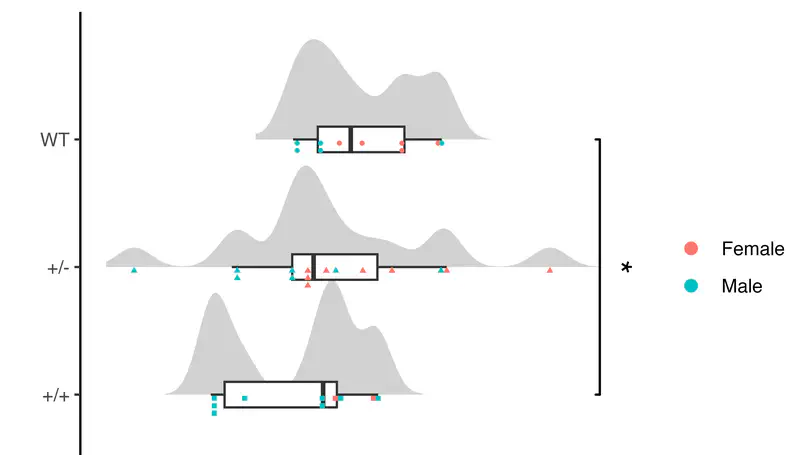
The McGill-R-Thy1-APP rat is a transgenic model of Alzheimer’s disease (AD) which expresses APP with two mutations found in cases of familial AD, resulting in the development of amyloid pathology and cognitive deficits. Motor deficits are common symptoms of AD, emerging early in the disease, and are correlated with AD neuropathology and cognitive symptoms. This study evaluated hemizygous and homozygous McGill-R-Thy1-APP rats and their wildtype littermates for spontaneous alternation and locomotion in the T and Y mazes, and motor behaviour on an accelerating rotarod at 12–13,months of age. We found no genotype or sex effects in spontaneous alternation in either maze, nor a significant correlation of spontaneous alternation behaviour between the mazes. Female rats travelled greater distances than male rats in both mazes. While there was no genotype effect in the T maze on distance travelled, in the Y maze the hemizygous rats travelled shorter distances than the wildtype rats, while the homozygous rats travelled greater distances. There was a significant correlation between the distances travelled in each maze. Both hemizygous and homozygous rats performed worse than their wildtype littermates on the rotarod, while heavier rats performed worse than lighter rats, and female rats performed worse than male rats once their differences in weights were accounted for. These findings support the continued use of these rats as a model of AD and highlight the need to consider the possible confounding effect motor impairments have on other behavioural tests.
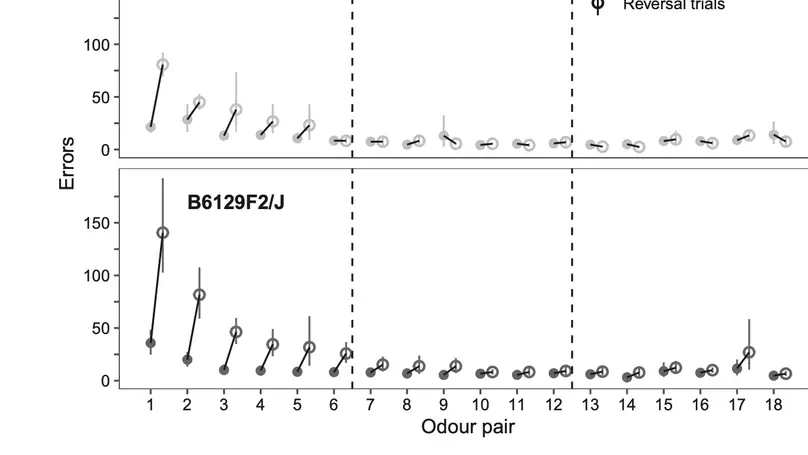
Male and female 3xTg-AD mice between 5 and 24 mo of age and their B6129F2/J wild-type controls were tested on a series of 18 olfactory discrimination and reversal tasks in an operant olfactometer. All mice learned the odor discriminations and reversals to a criterion of 85% correct, but the 3xTg-AD mice made fewer errors than the B6129F2/J mice in the odor discriminations and in the first six reversal learning tasks. Many mice showed evidence of near errorless learning, and on the reversal tasks the 3xTg-AD mice showed more instances of near errorless learning than the B6129F2/J mice. There was no evidence of an age effect on odor discrimination, but there was a decrease in errorless reversal learning in aged B6129F2/J mice. In long-term memory tests, there was an increase in the number of errors made but no genotype difference. The high level of performance indicates that the mice were able to develop a “learning to learn” strategy. The finding that the 3xTg-AD mice outperformed their littermate controls provides an example of paradoxical functional facilitation in these mice.