Interval Timing Is Altered in Male Nrxn1+/- Mice: A Model of Autism Spectrum Disorder
Abstract
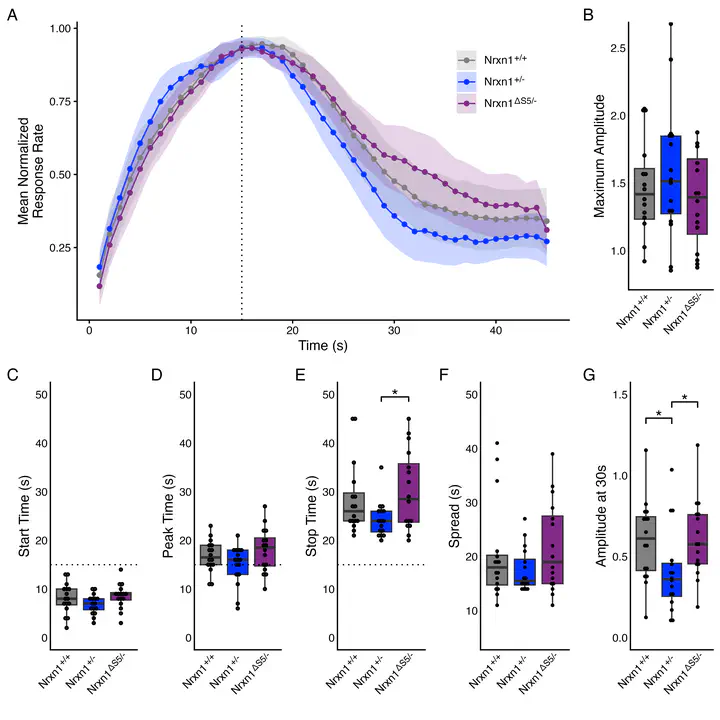
Autism spectrum disorder (ASD) is characterized by impaired social interactions and communication, and increased repetitive and stereotypical behavior. Neuroimaging shows functional abnormalities in brain areas involved in temporal processing in autistic individuals, and they also show deficits in interval timing. Neurexin (NRXN) mutations have been identified in a wide variety of neuropsychiatric disorders, including ASD, and Nrxn1+/- mice possess a mutation that disrupts the $α$, $β$, and $γ$ isoforms of Nrxn1, a gene involved in synapse structure. We investigated the interval timing abilities of the Nrxn1+/- mouse model of ASD in the peak interval procedure using a 15-s target interval and compared their performance with that of Nrxn1+/+ and Nrxn1$Δ$S5/- rescue mice. Two-month-old male Nrxn1+/+ (C57BL/6 J), Nrxn1+/-, and Nrxn1$Δ$S5/- mice were trained to obtain sucrose liquid rewards 15 s after the onset of a discriminative stimulus (discrete fixed-interval training), and their timing responses were tested in non-reinforced probe trials. Our analysis of responses across individual trials revealed that Nrxn1+/- mice had earlier timing responses overall. This difference was manifested as earlier termination of responding in terms of the response curves. These findings are consistent with leftward shifts observed with experimental animal models of ASD. In conclusion, we believe these results indicate a bias in long-term memory in the Nrxn1+/- mouse model of ASD and may capture the timing deficit observed in autistic individuals.
Open access pdf.

Kyle Roddick
Assistant Professor
Kyle Roddick is an assistant professor in the Department of Psychology, Mount Allison University.